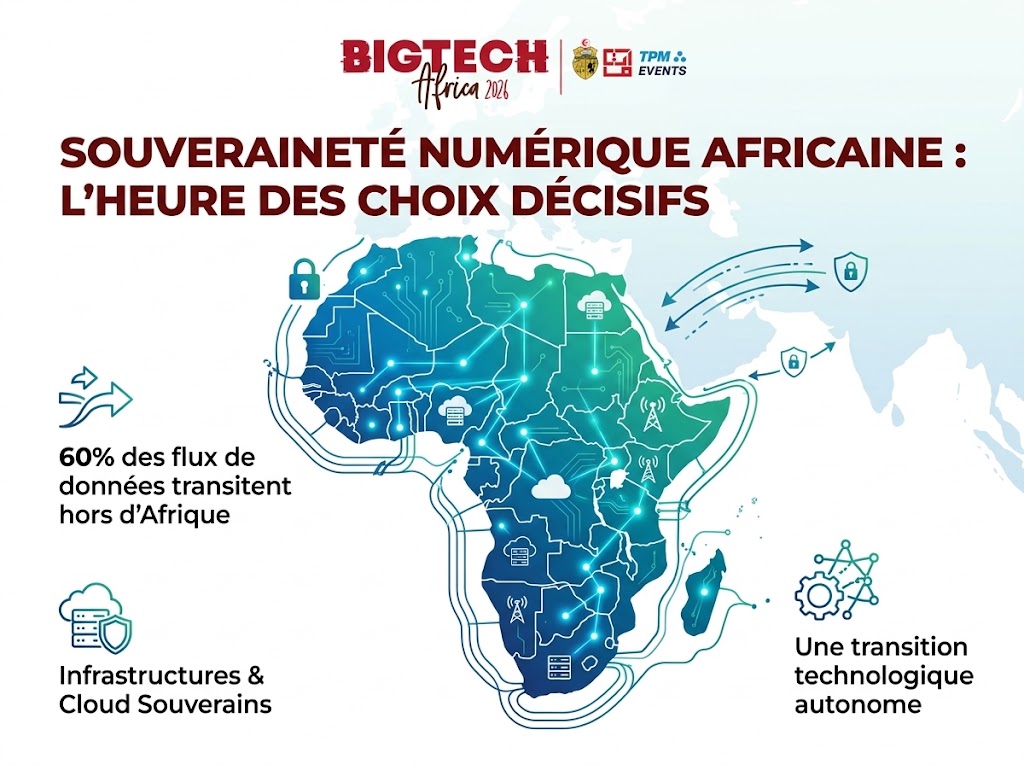
Tunis, City of Culture. The BIG TECH Africa 2026 trade show opens its doors on October 13, against a backdrop that is anything but trivial. As Western powers impose ever-more-stringent restrictions on access to key digital technologies (cloud services, semiconductors, AI models), Africa faces an existential question: how can it ensure its digital resilience without simply shifting from one form of dependence to another?
Dependence: A Grinding Tide
The figures are staggering. According to the World Bank, approximately 60% of Africa’s data traffic still passes through Europe, with each gigabyte subject to a “transit fee” of about 30%. This colonial digital architecture comes at a cost—financial, strategic, and political.
Dependence is not just infrastructural. It is also software-based. Seventy percent of African e-government platforms rely on Western proprietary code bases, according to an analysis published by *China Daily*. Every license, every update, every audit becomes a negotiation over sovereignty. And when geopolitical threats materialize (sanctions, export restrictions, diplomatic pressure), entire sectors of the government are thrown into turmoil.
This reality is all the more bitter given that Africa is not technologically behind. It is in a state of infrastructure capture. As the same analysis points out, “the question is not whether Africa will connect, but who will write the rules for that connection—and whether those rules will lead to dependence or to an equitable transition.”
Signs of a Counteroffensive
Faced with this reality, a movement is gaining momentum—tentative and fragmented, but real.
In Tunisia, the Tunisia-Africa Business Council launched the Alliance for Technological Sovereignty in Africa (STA) in June 2026. This pan-African consortium brings together Tunisian players in telecommunications, AI, cybersecurity, and high-value-added digital services. The ambition is clear: to collectively address the continent’s “structural projects” rather than letting each country negotiate alone against foreign giants.
In Kenya, the launch of Servernah Cloud in Nairobi marks a turning point. Hosted within the iXAfrica hyperscale data center (22.5 MW), this platform is billed as the country’s first sovereign cloud and AI infrastructure, designed for critical and regulated workloads. The economic argument is compelling: every dollar spent on a foreign cloud is value that does not remain in Africa.
In Nigeria, the DRC, and South Africa, the partnership between Open Access Data Centers (OADC) and UniCloudAfrica aims to host a sovereign cloud and AI infrastructure within carrier-neutral facilities. The logic is the same: to create the material conditions for real, not merely declarative, sovereignty.
In Algeria, the Global Africa Tech 2026 conference, held in March in Algiers, brought together 5,000 participants around an unambiguous theme: “All Networks, One Convergence.” President Tebboune called on African nations to “control the flow of our data, produce our own services, and create added value within our territories.”
Infrastructure as a Foundation: The Case of EO Data Center
Among the players embodying this momentum, EO Data Center (Tunisia) ranks among the Gold sponsors of BIG TECH Africa 2026. Under the leadership of its CEO, Achraf NAFFETI, the company has positioned itself in the sovereign data center segment—an essential building block for any local cloud strategy.
But Tunisia isn’t stopping there. A project to build a cluster of sustainable data centers is currently under development in the Bizerte Free Zone, 2 km from the submarine cable landing station, 1.5 km from the main high-voltage electrical substation, and 1 hour from Tunis International Airport. The stated goal: to provide high-performance computing capacity to Europe with a latency of less than 10 milliseconds. This positioning is not without ambiguity: serving Europe while asserting African sovereignty.
Cables: The Lifeblood of the Operation
It is impossible to discuss digital sovereignty without mentioning the physical infrastructure. The 2Africa submarine cable, 45,000 km long and connecting 33 countries, went into service in late 2025. Led by Meta alongside operators such as Vodafone, Orange, China Mobile International, and MTN’s Bayobab, it is billed as the world’s largest submarine cable system.
Its open-access model (any operator can purchase capacity under transparent terms) is a step forward. But vulnerabilities remain: more than half of Africa’s international bandwidth passes through just five countries. In 2024, cable breaks off the coast of West Africa simultaneously cut off connectivity for 13 countries.
Concentration remains the Achilles’ heel. One cut cable, and an entire region plunges into digital silence.
The Trap of “Sovereignty Under Guardianship”
Africa must guard against a rhetorical trap: that of conceded sovereignty. Certain infrastructure projects “offered” or financed by foreign powers become permanent sources of revenue for tech companies in the donor country. As a China Daily analysis bluntly puts it, “too many African states have received ‘free’ digital infrastructure that turns into permanent annuities for tech firms in the donor country.”
True sovereignty cannot be decreed. It is measured by the ability to update, audit, and abandon a system without external permission. It is this resilience that is still lacking.
What BIG TECH Africa 2026 Must Embody
The Tunisian trade show, with its 4,000 participants and 100 speakers, aims to be “a platform” rather than a mere event ( https://bigtech.africa ). Its “unapologetically South-South” positioning (Africa, the Gulf, Asia, the diaspora, with Europe as a partner rather than the sole focus) reflects a growing awareness.
But trade shows alone do not create sovereignty. It is actions that matter. Africa has the talent, the needs, and now part of the infrastructure. What is missing is continental coordination that transforms scattered initiatives into a resilient ecosystem.
The question is no longer whether Africa can achieve digital sovereignty. The question is whether it will do so before the doors close. And on this front, time is no longer on our side.